Issues of concern to people who live in the west: property rights, water rights, endangered species, livestock grazing, energy production, wilderness and western agriculture. Plus a few items on western history, western literature and the sport of rodeo... Frank DuBois served as the NM Secretary of Agriculture from 1988 to 2003. DuBois is a former legislative assistant to a U.S. Senator, a Deputy Assistant Secretary of Interior, and is the founder of the DuBois Rodeo Scholarship.
Showing posts with label Civil War. Show all posts
Sunday, February 07, 2016
Ethical Questions Surround Ammon Bundy’s Legal Team, Strategy
While Ammon Bundy was teaching others about his interpretation of the Constitution, lawyers were schooling him about potential violations of federal laws as the militant leader led the occupation at the Malheur National Wildlife Refuge. On Jan. 9, Lissa Casey of the Arnold Law Firm tweeted that she and Brian Boender, a fellow attorney from the Eugene Based Arnold Law Firm, met with some “very nice men” at the Malheur National Wildlife Refuge. On Jan. 14, Ammon Bundy confirmed he met with lawyers over the previous weekend; however, he didn’t name them.
“I did, and they had their suggestions, but look, we’re not breaking any laws,” Bundy said. “They made a list and shared it with us and we’ll keep that in mind, but again, the federal government has no authority on this land.”
Federal government officials disagree, and indicted Ammon Bundy along with fifteen others for keeping federal employees from “discharging their duties.”
To defend him against those charges, Bundy retained the Arnold Law Firm.
That retention could potentially be a violation of Oregon State Bar guidelines. Lissa Casey and Mike Arnold, the head of the Arnold Law Firm, confirmed that Ammon Bundy did not contact the firm, but rather attorneys for the firm went to meet the militants face-to-face.
“I felt duty-bound to give pro bono [emphasis: Casey’s] advice to the protesters out there given that they were practicing civil disobedience and didn’t appear to have any legal counsel,” Casey told OPB in a written statement.
That action could potentially violate Oregon bar rules, specifically, section 7.3. Portland criminal attorney Janet Hoffman said that the rule prohibits attorneys from soliciting clients by phone, electronic contact or in person. The rule specifically prohibits solicitation if one of the driving motivations for the attorney is financial gain.
In an email to OPB, Casey repeatedly emphasized that any legal advice given to Bundy and other militants was offered pro bono. But now that an indictment has been issued against Bundy and 15 others, Casey said the firm is charging for its services.
“We expect the litigation to be rather lengthy and expensive so he asked us to set him up with the crowd sourcing page to assist in raising funds,” Casey wrote.
As of Friday, Feb. 5, that page had raised about $27,000 of its $100,000 goal...more
Tuesday, October 08, 2013
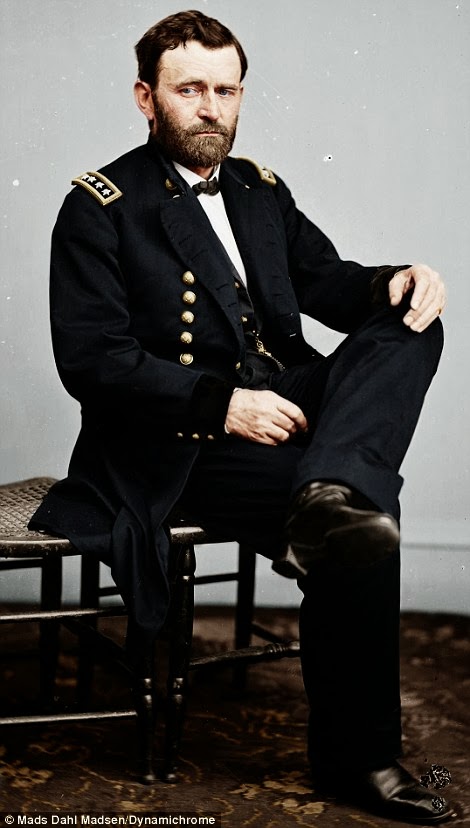
The Civil War in COLOR for the first time: Painstakingly remastered images
Of those published by Mail Online, I've selected the following to share here:
| |
| Abe Lincoln 1861 |
![]() |
| Robert E. Lee |
![]() |
| U.S. Grant |
![]() |
| Lt. General Thomas "Stonewall" Jackson |
![]() |
| Major General George Armstrong Custer |
![]() |
| 16 year old Confederate Soldier Edwin Francis Jemison, killed a year later at the battle of Malvern Hill |
Sunday, July 14, 2013
Historian Thomas Fleming Discovers the “Yankee Problem in America”
by Thomas J. DiLorenzo
Historian and novelist Thomas Fleming is the author of more than fifty books, including two very good revisionist histories of the two world wars: The New Dealers’ War, and The Illusion of Victory in World War I. He has authored biographies of George Washington and Benjamin Franklin, and has written extensively about the founding generation, including his best-selling book, Liberty! As a regular on PBS and NPR he is as “mainstream” as it gets. That is, he was, until he published his latest book, A Disease in the Public Mind: A New Understanding of Why We Fought the Civil War...
The inside cover of the book asks, “Why was the United States the only nation in the world to fight a war to end slavery?” The standard “answer” to this question, which I have asked many times in my own writings, is that Southern plantation owners were by far the most evil human beings in world history, far more evil than British slave owners, Spanish slave owners, or French, Danish , Dutch and Portugese slave owners. Therefore, no peaceful means of ending slavery was ever possible. This of course makes no sense at all, and Thomas Fleming recognizes it.
He points out that “Only 316,632 Southerners owned slaves – a mere 6 percent of the total white population.” This leads Fleming to ask the obvious question: “Why did the vast majority of the white population unite behind these slaveholders in this fratricidal war? Why did they sacrifice over 300,000 of their sons to preserve an institution in which they apparently had no personal stake?”
Fleming actually understates this point: Slavery only benefited the slave-owners who exploited the slaves but was economically harmful to all the rest of Southern society because slave labor is inherently inferior to free labor. The entire South was poorer as a result. Moreover, the average Confederate soldier, who was a yeoman farmer who owned no slaves, was harmed by the slave-owning plantation owners through unfair competition. That is why so many Northern states like Illinois banned the migration of blacks, free or slave, from their borders, and it is also the main reason why the Republican Party opposed the extension of slavery into the new territories – they wanted to “preserve them for free white labor,” as Lincoln himself once said. In every major Civil War battle Confederate soldiers who did not own slaves fought against (mostly border state) Union Army soldiers, such as Ulysses S. Grant, who did own slaves (Grant’s wife Julia, cousin of Confederate General James Longstreet, inherited slaves from her South Carolina family and Grant was the overseer of his father-in-law’s slave plantation for a period of time before the war).
Fleming contends that the real reason for the war – and for why, of all the nations on earth, only the U.S. associated war with the ending of slavery – was twofold: First, there was the extreme “malevolent envy” of Southerners by the New England “Yankee” political class, who had long believed that they were God’s chosen people and that they should rule America, if not the rest of the world. Second, there were a mere 25 or so very influential New England abolitionists who had abandoned Christianity and even condemned Jesus Christ, while embracing the mentally insane mass murderer John Brown as their “savior.” This is part of the “disease in the public mind” that is the theme of Fleming’s book...
Historian and novelist Thomas Fleming is the author of more than fifty books, including two very good revisionist histories of the two world wars: The New Dealers’ War, and The Illusion of Victory in World War I. He has authored biographies of George Washington and Benjamin Franklin, and has written extensively about the founding generation, including his best-selling book, Liberty! As a regular on PBS and NPR he is as “mainstream” as it gets. That is, he was, until he published his latest book, A Disease in the Public Mind: A New Understanding of Why We Fought the Civil War...
Fleming has discovered what scholars such as the late, great Murray Rothbard and the not-late-but-still-great Clyde Wilson wrote about many years ago: A war was not necessary to end slavery – the rest of the world did it peacefully; only 6 percent of adult Southern men owned slaves, which means that the average Confederate soldier was not fighting to preserve a system that actually harmed him and his family economically; and that the real cause of the war was what Fleming calls a “malevolent envy” of the South by New England “Yankees” who waged a war of economic conquest. In his own words, from the inside front cover of A Disease in the Public Mind:
[Northern] hatred for Southerners long predated their objections to
slavery. Abolitionists were convinced that New England, whose
spokesmen had begun the American Revolution, should have been
the leaders of the new nation. Instead, they had been displaced by
Southern “slavocrats” like Thomas Jefferson.
slavery. Abolitionists were convinced that New England, whose
spokesmen had begun the American Revolution, should have been
the leaders of the new nation. Instead, they had been displaced by
Southern “slavocrats” like Thomas Jefferson.
Fleming actually understates this point: Slavery only benefited the slave-owners who exploited the slaves but was economically harmful to all the rest of Southern society because slave labor is inherently inferior to free labor. The entire South was poorer as a result. Moreover, the average Confederate soldier, who was a yeoman farmer who owned no slaves, was harmed by the slave-owning plantation owners through unfair competition. That is why so many Northern states like Illinois banned the migration of blacks, free or slave, from their borders, and it is also the main reason why the Republican Party opposed the extension of slavery into the new territories – they wanted to “preserve them for free white labor,” as Lincoln himself once said. In every major Civil War battle Confederate soldiers who did not own slaves fought against (mostly border state) Union Army soldiers, such as Ulysses S. Grant, who did own slaves (Grant’s wife Julia, cousin of Confederate General James Longstreet, inherited slaves from her South Carolina family and Grant was the overseer of his father-in-law’s slave plantation for a period of time before the war).
Fleming contends that the real reason for the war – and for why, of all the nations on earth, only the U.S. associated war with the ending of slavery – was twofold: First, there was the extreme “malevolent envy” of Southerners by the New England “Yankee” political class, who had long believed that they were God’s chosen people and that they should rule America, if not the rest of the world. Second, there were a mere 25 or so very influential New England abolitionists who had abandoned Christianity and even condemned Jesus Christ, while embracing the mentally insane mass murderer John Brown as their “savior.” This is part of the “disease in the public mind” that is the theme of Fleming’s book...
Fleming discusses in great detail how John Brown came to replace Jesus Christ in the minds of Northern abolitionists, who adopted his mantra that blood must be shed in order to eradicate sin. That is, if they were to be saved and sent to Heaven, there must be bloodshed, and the more the better. That is why peaceful emancipation was not achieved in America, writes Fleming: It was not stubborn and evil Southern plantation owners who were the problem, it was the bloodthirsty abolitionists.
John Brown “descended from Puritans” and was “the personification of a Puritan,” says Fleming. And he truly became a “god” to the New England “Yankees.” “Ralph Waldo Emerson expressed awe and near-worship of John Brown,” writes Fleming. He lavished praise on John Brown’s “religion of violence.” Emerson called Brown “that new saint” who “would make the gallows as glorious as the cross.” Henry David Thoreau said that “Brown was Jesus.” He was “the bravest and humanest man in the country,” said Thoreau with horribly clunky English. He described Brown in that way after learning of Brown’s execution of non-slaveowning, innocents in front of their wives and children...
Thomas Fleming points out that the husband of Julia Ward Howe, author of the “Battle Hymn of the Republic,” was one of the financiers of John Brown’s terrorist mass murder sprees. Her song replaced “John Brown’s Body” as the Yankee anthem as it celebrated the mass murder of hundreds of thousands of fellow citizens as “the glory of the coming of the Lord.”
Thomas Fleming discusses many other historical facts in A Disease in the Public Mind that yours truly has also written about and been denounced as a a liar, a slavery defender, a “Neo-Confederate,” and worse. He praises Thomas Jefferson for being among the first American statesmen to propose the peaceful emancipation of Southern slaves. He describes in detail the breathtaking hypocrisy of New Englanders who “rediscovered the sacred union,” he writes sarcastically, after having plotted to secede from the union for a dozen years after Jefferson’s election as president.
Fleming also writes of how the “Yankees” habitually attempted to plunder the South with protectionist tariffs that protected their manufacturers from competition. He understood that the Republican Party’s opposition to the extension of slavery into the new territories was based on their wish of “Free Soil for Free (White) Men,” the title of chapter 19. That is, they wanted a Homestead Act that would hand out free land to white settlers while banning the existence of all black people, free or slave. He quotes Lincoln’s letter to Horace Greely explaining that his “paramount objective” was to “save the union” and not to end slavery.
Sunday, May 08, 2011
Do we need federal involvement in commemorating the Civil War?
No, no, no says Danny Tyree in this hilarious column. He says we're too busy meddling in other folks civil wars to commemorate our own. Besides, the feds would prevent federal re-enactors from raiding hen houses unless the farmer had posted detailed nutritional data on the barn door.
Sunday, April 24, 2011
The Sesquicentennial Is Upon Us
...But first I think it’s important to remember that the secession that took place 150 years ago was in a grand old American tradition. The American “Revolution” was, in fact, a war of secession – 13 colonies breaking away from the British Empire – not a war of conquest, and most of the Founding Fathers understood that to be a given right when they created the Articles and then the Constitution. The creation of the Republic of Vermont in 1777 was another act of secession, from both New Hampshire and New York. And just 25 years after the new nation was born, representatives from all New England states (only one from Vermont) met at a convention in Hartford to consider secession from the United States if their grievances against President Madison’s conduct of the war of 1812 and limitations on Atlantic trade were not satisfied; in the event, they did not vote for secession, but its spirit was in the air. So in that context, let’s make clear that what began 150 years ago this April was not a true civil war, except in the sense that there were two sides in one country, because there was no attempt by one side to take over the other, as in the more familiar English civil war between Parliament and Charles I. The South did not want to run the Union, it wanted out of the Union. That makes it a war of secession
Tuesday, April 19, 2011
The Regime’s 150th Birthday
Today marks the 150th anniversary of the beginning of the Civil War. This event, more than the Declaration of Independence, Constitution or the American Revolution, signifies the true birth of the modern American nation-state. It was on this day that the federal government first repudiated the Founding Fathers’ republican form of government—a coalition of several states that combined under the Constitution to form a central state of enumerated and sharply limited powers—and asserted a plenary sovereignty over the people. Rejecting the right of states to secede, the federal government under Lincoln abolished the very system that was supposed to come out of the revolution against the British crown, a system where smaller political units could exercise their legal and human right to overthrow or at least leave the central government that ruled them without their consent. During the U.S. Civil War, leviathan as we know it was born. The war ushered in federal conscription, income taxes, new departments and agencies, and the final victory of the Hamiltonians over the Jeffersonians. For years, the nationalists—first the Federalists, then the Whigs, and then the Republicans under Lincoln—had advocated a system that subordinated the states to the central government and buried agrarianism and free enterprise under the heavy burden of corporarist neo-mercantilism. Henry Clay called this economic program “The American System” and boasted of its proposed “internal improvements.” A more modern label would simply be “corporate welfare” as these nationalists were championing high tariffs to discourage free trade and to raise revenue that could be shoveled toward big businesses that would build railways, canals and roads, the circulatory system of a new corporate state with Washington directing the economy through grants of privilege and monopoly. Civil liberties took a hit virtually unparalleled in U.S. history, with the possible exception of World War I. During the Civil War, thousands of dissidents were arrested, hundreds of newspapers were shut down, martial law was declared, habeas corpus was suspended, and political enemies were targeted for arrest and persecution...more
Tuesday, April 12, 2011
Paul Krugman’s 'Civil War' Fantasies
Krugman said he has always been infatuated by the "symbolism" of Lee’s surrender at Appomattox, with "Lee the patrician in his dress uniform," compared to General Grant, who was "still muddy and disheveled from hard riding." Krugman is apparently unaware that by the late 1850s, on the eve of the war, Robert E. Lee was in his thirtieth year as an officer in the United States Army, performing mostly as a military engineer. He was hardly a "patrician" or member of a ruling class. Grant, by contrast, was the overseer of an 850-acre slave plantation owned by his wealthy father-in-law. The plantation, located near St. Louis, was known as "White Haven" (which sounds like it could have been named by the KKK) and is today a national park. (On the "White Haven" Web site the National Park Service euphemistically calls Grant the "manager" of the slave plantation rather than the more historically-accurate word "overseer"). In 1862 Lee freed the slaves that his wife had inherited, in compliance with his father-in-law’s will. Grant’s White Haven slaves were not freed until an 1865 Missouri emancipation law forced Grant and his father-in-law to do so. The fact that Lee changed clothes before formally surrendering did not instantly turn the 36-year army veteran into a "patrician," contrary to the "all-knowing" Krugman’s assertion. Krugman goes on to assert that the North’s victory in the war was a victory in "manners" by a region that "excelled at the arts of peace." Well, not really. What the North "excelled" in was the waging of total war on the civilian population of the South. The Lincoln administration instituted the first federal military conscription law, and then ordered thousands of Northern men to their death in the savage and bloody Napoleonic charges that characterized the war. When tens of thousands of Northern men deserted, the Lincoln administration commenced the public execution of deserters on a daily basis. When New Yorkers rioted in protest of military conscription, Lincoln ordered 15,000 soldiers to the city where they murdered hundreds, and perhaps thousands of draft protesters (See Iver Bernstein, The New York City Draft Riots). It also recruited thousands of European mercenaries, many of whom did not even speak English, to arm themselves and march South to supposedly teach the descendants of James Madison, Patrick Henry, and Thomas Jefferson what it really meant to be an American...more
Wednesday, April 06, 2011
Balerio led Union raiders during the Civil War
Cecilio Balerio, a Nueces County rancher and horse-trader, commanded 120 men in an irregular Union cavalry outfit that rustled cattle and attacked Confederate wagon trains carrying cotton down the Cotton Road. Balerio's raiders lived in the brush and prowled the remote Wild Horse Desert. Before the war, Balerio traded horses and mules around Corpus Christi. He also had a reputation for stealing horses. Maria von Blucher in a letter to her parents in Germany wrote that the Blucher remuda of horses was stolen by Balerio, "a noted horse thief. Among them was my pretty chestnut mare; so probably she is gone, along with the rest." When the Civil War broke out, E.J. Davis, former Corpus Christi judge who became a Union leader, enlisted Balerio to attack wagon trains carrying cotton down the Cotton Road between Corpus Christi and the Rio Grande. Balerio's outfit was, nominally, under the command structure of John Haynes' Second Regiment of Texas Cavalry (Union). But Balerio operated on his own, committing what the Confederates considered subversive activities and opportunistic marauding. Balerio was 65 in 1861. He was assisted by two sons: an older son named Juan and 19-year-old Jose Mario. Balerio was in contact with Union commanders in Matamoros and later in Brownsville. He supplied Union forces with beef cattle rounded up from South Texas ranches. He also was in contact with Union blockade ships standing to off the Aransas Pass channel. The ships supplied Balerio with Burnside Carbines, Colt revolvers, blankets, and paid him in gold for his guerrilla activities against the Confederacy...more
Saturday, March 12, 2011
Another Court Historian’s False Tariff History
Loewen next spreads an egregious falsehood about the tariff: "Tariffs were not an issue in 1860, and Southern states said nothing about them," he writes. "Why would they? Southerners had written the tariff of 1857, under which the nation was functioning. Its rates were lower than at any point since 1816." Every bit of this narrative is false. Tariffs certainly were an issue in 1860. Lincoln’s official campaign poster featured mug shots of himself and vice presidential candidate Hannibal Hamlin, above the campaign slogan, "Protection for Home Industry." (That is, high tariff rates to "protect home industry" from international competition). In a speech in Pittsburgh, Pennsylvania ("Steeltown, U.S.A."), a hotbed of protectionist sentiment, Lincoln announced that no other issue was as important as raising the tariff rate. It is well known that Lincoln made skillful use of his lifelong protectionist credentials to win the support of the Pennsylvania delegation at the Republican convention of 1860, and he did sign ten tariff-increasing bills while in office. When he announced a naval blockade of the Southern ports during the first months of the war, he gave only one reason for the blockade: tariff collection. As I have written numerous times, in his first inaugural address Lincoln announced that it was his duty "to collect the duties and imposts," and then threatened "force," "invasion" and "bloodshed" (his exact words) in any state that refused to collect the federal tariff, the average rate of which had just been doubled two days earlier. He was not going to "back down" to tax protesters in South Carolina or anywhere else, as Andrew Jackson had done...more
Thursday, March 10, 2011
Lincoln asked Britain to help set up colony for freed slaves
Abraham Lincoln told freed slaves they should found a colony in Latin America, and even made contact secretly with the British about making land available in what was then British Honduras, now Belize, according to a new book. As America celebrates the 150th anniversary of Lincoln's first inauguration this week, a new book by researchers at George Mason University in Fairfax, Virginia, makes the case that Lincoln was more committed to colonising black people than previously thought. The book, Colonization After Emancipation, is based in part on newly uncovered documents that authors Phillip Magness and Sebastian Page found at the British National Archives in Kew and in the US National Archives. It claims, among other things, that in 1862 Lincoln urged a White House audience of "free blacks" to leave the US and settle in Central America. He told them: "For the sake of your race, you should sacrifice something of your present comfort for the purpose of being as grand in that respect as the white people." He went on to say that those who envisioned a permanent life in the US were being "selfish" and he promoted Central America as an ideal location "especially because of the similarity of climate with your native land – thus being suited to your physical condition". Lincoln's views about colonisation are well known to historians, even if they don't make it into most schoolbooks. Lincoln even referred to colonisation in the preliminary Emancipation Proclamation, his September 1862 warning to the South that he would free all slaves in southern territory if the rebellion continued...more
Thursday, February 24, 2011
Abraham Lincoln rides to Washington, 150 years later
So began the federal government's commemoration of the last leg of Lincoln's journey to Washington 150 years ago Wednesday, and the National Park Service's official Civil War sesquicentennial observance. Baltimore was his next-to-last stop. He had been on the road for 13 days, having stopped in 17 cities and addressed thousands of people across almost 2,000 miles, aides said. But soon he would be in Washington, where his inauguration was scheduled for March 4 - 1861. Wednesday's event was marked by historical similarities - Lincoln was portrayed by Springfield actor Fritz Klein, 62, who, like Lincoln, stands 6 feet 4 inches tall and sports real whiskers. The train was met at Union Station by Interior Secretary Ken Salazar, in his trademark black cowboy hat, and a mob of reporters. The faux Lincoln was accompanied by National Park Service Director Jonathan B. Jarvis. "This is the first, most significant beginning of the Civil War sesquicentennial," Jarvis said in Baltimore before the trip started. "What we're using this opportunity for . . . is to really . . . deepen the discussion about the cause of the Civil War."...more
Monday, February 21, 2011
Lincoln papers found in closet
The house was a nondescript, three-bedroom, Silver Spring rancher that had been vacant for 10 years. It was filled with dust bunnies and old pocketbooks. And Laurie Zook, who prepares such houses for sale, didn't expect much more. But when she opened an old scrapbook that was stacked amid a pile of other volumes in a bedroom closet, she found links to a painful, bygone time, and a rare ticket to one of the nation's greatest tragedies. Pasted among the pages was a small, black-bordered card that read: "admit the bearer" to the White House on Wednesday, April 19, 1865, the day of Abraham Lincoln's funeral service there. It is believed to be one of only 600 such tickets printed, was highly sought at the time and may be one of the few still in existence. Also among the pages were two brief notes from Lincoln that seemed to be pardons of a soldier for some unknown offense, inked with the distinctive "A.Lincoln" signature. The documents are now available for sale via an online auction...more
Friday, February 11, 2011
Book: Lincoln sought to deport freed slaves
The Great Emancipator was almost the Great Colonizer: Newly released documents show that to a greater degree than historians had previously known, President Lincoln laid the groundwork to ship freed slaves overseas to help prevent racial strife in the U.S. Just after he issued the Emancipation Proclamation in 1863, Lincoln authorized plans to pursue a freedmen’s settlement in present-day Belize and another in Guyana, both colonial possessions of Great Britain at the time, said Phillip W. Magness, one of the researchers who uncovered the new documents. Historians have debated how seriously Lincoln took colonization efforts, but Mr. Magness said the story he uncovered, to be published next week in a book, “Colonization After Emancipation: Lincoln and the Movement for Black Resettlement,” shows the president didn’t just flirt with the idea, as historians had previously known, but that he personally pursued it for some time. “The way that Lincoln historians have grappled with colonization has always been troublesome. It doesn’t mesh with the whole ‘emancipator,’ ” Mr. Magness said. “The revelation of this story changes the picture on that because a lot of historians have tended to downplay colonization. … What we know now is he did continue the effort for at least a year after the proclamation was signed.”...more
Monday, February 07, 2011
The Civil War at 150
Despite its natural overlap with American constitutionalism and a thoroughly classical liberal antislavery tradition, the Civil War can be a treacherous, and even hostile, subject matter for classical liberal historians to navigate. Even a century and a half later the subject remains an emotional one, tied to complex moral and economic questions, iconic historical figures, regional and national identities, and race. The war itself has a legacy among historians of attracting veritable partisans to one of the two belligerents, yet neither side offers a particularly welcoming home for classical liberal purists. While it largely emerged from a tradition of decentralized federalism, secession itself being a logical extension of Jeffersonian states rights, any libertarian inclination of enthusiasm for the Confederacy is inescapably tempered by its expressly pro-slavery designs and the moral abhorrence of the plantation system. The Union makes an equally problematic, if less frequently admitted, cause for libertarians to champion - not for want of its ultimate anti-slavery results but in its highly problematic means of attainment and, perhaps more importantly, its lasting centralizing effects upon the federal government. In the subsequent 150 years, proponents of the income tax, militarized societies and preemptive warfare, military tribunals, protectionism, fluid constitutional constructions, and any number of other similar policies have enlisted the Union as a "virtuous" precedent for their causes. The paradoxical implications of the Civil War as both a liberating and centralizing event have troubled classical liberal thinkers since the cannon fire ceased in 1865...more
Did Tariffs Really Cause the Civil War? The Morrill Act at 150
Did protective tariffs really bring about the Civil War? It's an argument that enthusiasts of the era are bound to encounter at some point, and also among the most contentious and least understood of the many debates surrounding the instigating causes of secession 150 years ago this month. The tariff thesis is contentious because it is often interpreted as an attempt to displace the primacy of slavery as the underlying instigator of events in Civil War causality. In this simplified form, the argument may be easily disposed of by referring to South Carolina's Declaration of Immediate Causes, which attributed their action to "an increasing hostility on the part of the non-slaveholding States to the institution of slavery." Yet as we will see, the tariff issue cannot be completely discounted from the discussion of Civil War causality...To state that tariffs were not an issue in 1860 is itself "flatly wrong," as my recent article in the Journal of the Early Republic illustrates. Nor was the Tariff of 1857 the source of southern angst, but rather the Morrill Tariff of 1861, which had been the subject of an intense political feud in Congress for some two years prior and an issue in the presidential election of 1860...So where did the tariff issue stand on the eve of the Civil War? Like so many other facets of American politics at the time, it stood in the middle of a complex and heated political fight that fell largely on North-South sectional lines...more
Wednesday, January 19, 2011
Robert E. Lee Revisited, 150 Years After Civil War
Confederate Gen. Robert E. Lee still holds a distinct place in the history of the South — a history that will be revisited many times in 2011, as the nation marks 150 years since the Civil War began. That bloody conflict continues to resonate in culture and politics to this day, as Americans continue to debate the legacy of slavery and states' rights, and consider the extent of federal authority. NPR's Neal Conan spoke with historian Noah Andre Trudeau, reporter Mary Hadar, and Joseph Riley, Mayor of Charleston, S.C. about how and why we mark the anniversary Civil War. Trudeau, author of Robert E. Lee, says Southern leaders turned Lee into an icon as a way to save face after the destructive war. "They came up with the lost cause," says Trudeau. That explanation re-framed the war and their losses in terms of the South's pride and perceived moral high ground, and cast the North's win as simply about their greater numbers. "They needed that iconic leader at the top of the heap, and Lee was the one they chose." Washington Post projects editor Mary Hadar has been tweeting the events leading up to the secession of South Carolina. She's using original documents to compose her tweets, and has been struck by the emotional pull the material has on her. For example, Maj. Robert Anderson, the commander of Fort Sumter, was a "a heroic figure," she says, torn by the realities of fighting with the Union, against fellow Southerners fighting for the Confederacy...more
Robert E. Lee: A Man Without a Country for 110 Years
Several states officially recognize and celebrate January 19 as Robert E. Lee’s birthday, including the state of Virginia as part of Jackson-Lee Day which falls on the Friday before the third Monday in January, Martin Luther King Day. The state of Texas celebrates Lee’s birthday on the 19th of January as part of Confederate Heroes Day, while Alabama, Arkansas and Mississippi celebrate it concurrently with MLK day.
Lee was also, following the end of the war, a man without a country.
In agreeing upon terms of the surrender of his army at Appomattox Court House on April 9, 1865, Lee appointed three officers to oversee the parole of his army. The Proclamation of Amnesty and Pardon for Lee’s soldiers that resulted had several excepted classes, including field commanders who had to make a special application to the president to regain full citizenship in the Union. Since Lee was excepted, he applied to President Grant, and sent this letter to President Johnson on June 13, 1865:
On October 2, 1865, Lee signed his Amnesty Oath which says, in part, "I, Robert E. Lee, at Lexington, Virginia, do solemnly swear, in the presence of almighty God, that I will henceforth faithfully support, protect and defend the Constitution of the United States, and the Union of the States thereunder, and that I will, in like manner, abide by and faithfully support all laws and proclamations which have been made during the existing rebellion with reference to the emancipation of slaves, so help me God."
That Oath, however, was never processed until an archivist at the National Archives discovered it in 1970. On August 5th, 1975 a joint resolution by both houses of Congress was signed into law by President Gerald Ford, finally giving Robert E. Lee, the man without a country for 110 years, full rights of citizenship. As President Ford said:
Bob Adelmann
Lee was also, following the end of the war, a man without a country.
In agreeing upon terms of the surrender of his army at Appomattox Court House on April 9, 1865, Lee appointed three officers to oversee the parole of his army. The Proclamation of Amnesty and Pardon for Lee’s soldiers that resulted had several excepted classes, including field commanders who had to make a special application to the president to regain full citizenship in the Union. Since Lee was excepted, he applied to President Grant, and sent this letter to President Johnson on June 13, 1865:
Being excluded from the provisions of amnesty & pardon contained in the proclamation of the 29th [of May], I hereby apply for the benefits & full restoration of all rights & privileges extended to those included in its terms.
I graduated at the Military Academy at West Point in June, 1829. Resigned from the U. S. Army [in] April, 1861. Was a General in the Confederate Army, & included in the surrender of the Army of Northern Virginia 9 April, ’65.
That Oath, however, was never processed until an archivist at the National Archives discovered it in 1970. On August 5th, 1975 a joint resolution by both houses of Congress was signed into law by President Gerald Ford, finally giving Robert E. Lee, the man without a country for 110 years, full rights of citizenship. As President Ford said:
This legislation corrects a 110-year oversight of American history….Lee’s dedication to his native State of Virginia charted his course for the bitter Civil War years, causing him to reluctantly resign from a distinguished career in the United States Army and to serve as General of the Army of Northern Virginia. He, thus forfeited his rights to U. S. citizenship….
Lee’s character has been an example to succeeding generations, making the restoration of his citizenship an event in which every American can take pride...
Bob Adelmann
New York Ignores Its Civil War History
The standard narrative is that slavery was a Southern institution and the north, including New York fought to preserve the union and end slavery. But the reality of history is never so simple. For example, as a Congressman in the 1840s, New Yorker Fernando Wood was a strong supporter of slavery and the South. He continued his support of the South when he became Mayor of New York City in the 1850s. On January 8, 1861, the New York Times published the transcript of Mayor Fernando Wood's annual report to the city's Common Council. In this message, Wood spoke about the city's options as the United States federal union appeared to be dissolving and he called for the city to secede as well. Woods told the Common Council, "It would seem that a dissolution of the Federal Union is inevitable." He reminded its members that with their "aggrieved brethren of the Slave States we have friendly relations and a common sympathy" because "we have not participated in the warfare upon their constitutional rights or their domestic institutions." He proposed that "New York should endeavor to preserve a continuance of uninterrupted intercourse with every section," and to do this it should secede from the Union itself and become "a free City." Wood concluded, "When disunion has become a fixed and certain fact, why may not New York disrupt the bands which bind her to a corrupt and venal master. New York, as a Free City, may shed the only light and hope for a future reconstruction of our once blessed Confederacy." Wood's sentiments were supported by the New York Herald and the Journal of Commerce. The Herald published a statement by department store magnet Alexander Stewart charging that "the refusal at Washington to concede costs us millions daily." The Journal of Commerce warned President-elect Lincoln that, "there are a million and a half mouths to be fed daily in this city and its dependencies; and they will not consent to be starved by any man's policies."...more
Cherokee Nation Court Rules in Favor of Descendents of Slaves
A Cherokee Nation judge ruled Friday that the descendants of freed Cherokee slaves are protected citizens of the tribe under an 1866 treaty, throwing out a tribal constitutional amendment that required tribal blood for citizenship. The issue of freedmen citizenry has spawned repercussions far beyond Tahlequah, where the Cherokee Nation of Oklahoma is based. Some Democratic members of Congress, mostly blacks, filed legislation aimed at stripping the tribe of federal funds and called for a Justice Department investigation. The tribe mounted a multimillion-dollar public relations and lobbying blitz to counter the congressional effort, and the legislation never advanced in a Democrat-controlled House. In the decision Friday, Cherokee Nation District Court Judge John Cripps wrote that the post-Civil War treaty signed by the Cherokee Nation and the U.S. government specifically addressed the status of freedmen — former slaves who had been owned by tribal members. The treaty provided that freedmen and their descendants “shall have all the rights of native Cherokees,” Cripps wrote. The nation is still bound by the treaty, Cripps wrote. Though the French, Spanish, English and U.S. governments have violated treaties made with the tribe, Cripps said, “This does not mean that the Cherokee Nation should descend into such manner of action and disregard their pledges and agreements.”...more
BOOK REVIEW: Twin journeys at Civil War's end
BLOODY CRIMES: THE CHASE FOR JEFFERSON DAVIS AND THE DEATH PAGEANT FOR LINCOLN'S CORPSE By James L. Swanson Morrow, $27.99, 464 pages The Civil War filled four years with death and destruction. Politicians on both sides vastly underestimated the human carnage from the conflict they were about to ignite. The Union was preserved, but at a cost of 620,000 dead. The contending leaders suffered grievously for their roles. Abraham Lincoln was assassinated before the last Confederate forces laid down their arms. Jefferson Davis was captured on the run and subjected to punitive imprisonment. Historian James Swanson nicely juxtaposes the different experiences of the two men, one carried on a funeral train to his burial place while the other was being carried by horse away from the former's invading forces. Although their lives at the end of the Civil War dramatically diverged, their deaths converged. Explains Mr. Swanson: "Just as April 15, 1865, symbolized to the North more than the death of just one man, so too the death pageant that followed December 6, 1889, was not for Davis alone."...more
Subscribe to:
Posts (Atom)